Keeping Resolutions in Hectic Times

One of my 2023 professional resolutions is THIS BLOG! Keeping a regular record of professional experiences/thoughts throughout the year is a way for work-from-home freelancers to take stock of their own practice and connect with others. But when work requests, new collaborations, and public holidays (looking at you, May in France) start to accumulate, blogging, along with networking, professional development, and even personal hygiene (I kid, sort of) are quickly abandoned.

Recently, between springtime strikes and a succession of Gallic long weekends, getting things done–anything–has felt like an Oscar-winning accomplishment. Because, when you are a parent, disruptions to childcare mean Herculean behind-the-scenes efforts to keep things running smoothly. When finalizing a big project with a client last week, I nearly sent along a list of credits to thank everyone from the babysitter (and her last-minute availability) to the nice man at the café where I work on strike days who brought me an extension cord at a critical moment.

How do you stick to resolutions when time is scarce and demands are high? Well, I see it’s been two months since I’ve written a blog post, so part of the answer may be that it’s okay to fall behind on less urgent tasks. I can have a rigid mindset when I set out to accomplish something, but I’m learning to let go of some things when it simply becomes impossible to do it all (this applies to a lot in life). I like to remind myself that, even in the superego-driven world of resolutions, there is space for taking a break, with the idea that I will come back to my goal when things settle down.

Another way to manage resolution expectations is to lower them. I’m not saying that we should be turning in shoddy work. But I would say that not all tasks require the same level of dedication. Blog posts are a good example. I want to put out posts that allow me to connect with others and think through professional questions. My aim here is not to write great literature. Setting aside 15-30 minutes can feel doable, even during a busy week. The prose won’t be Martin Amis (sigh), but I will be able to engage on a question that’s been circling around in my head.

Finally, and this gets back to my fantasy list of credits, I try to seek help when and where I can. This can take the form of technology: I have fully embraced AI as a tool for some types of tasks (see Rachel Pierce’s very practical article on how linguists can leverage AI in their work: https://www.atanet.org/business-strategies/5-tedious-non-translation-tasks-chatgpt-can-do-amazingly-well/). Or it can be human. I’ve taken to asking my toddler to ‘help Mom work’ by playing with his toys. Last week, he even made me a fresh-squeezed OJ while I responded to emails.

4 ways becoming a parent has made me better at my job

It’s no secret that becoming a parent, the mom kind in my case, completely changes one’s relationships, priorities, body, home, work–everything. Anthropologists have even coined the term matrescence (contraction of maternity and adolescence) to describe the radical transformation that takes place, even at a cellular level, in a woman’s life when she becomes a mother. But for some reason (media representations? the social disconnect between parents and non-parents? willful disbelief? biological blindness?), in the months leading up to becoming a first-time mom, I had no idea what to do to prepare my career for what was about to happen. This is a vital issue, particularly for freelancers, particularly for mothers (still in 2023, for all kinds of reasons), which I will definitely address more directly in a future blog post. Suffice it to say that getting back to full-time work as an independent translator has been hard fought. But in addition to the challenges of mothering a small child while also trying to rebuild, sustain, and grow an independent business, there have been some surprising benefits. As I reflect on my matrescence applied to the world of work, I can honestly say that since giving birth to my son, I have become better at my job in at least 4 important ways. And I am genuinely curious to hear about other people’s experiences. Do you think having children has had a positive impact on your professional self? And in what ways?

  1. PRACTICAL KNOWLEDGE

As a linguist, I rely on all kinds of life experiences to get the language just right for a given text. Prior to becoming a mother, I worked on accounts for children’s brands. In the pre-child years, I had to spend extra time researching vocabulary and concepts specific to the world of early parenthood. Today, understanding the difference between a sleep sack and footed pajamas has gone beyond intellectual knowledge, it has become a part of my own story. I now know, on a deep level, what these kinds of objects mean to parents of babies, and I believe that shows through in my work. As my son grows, his interests begin to fan out beyond my own tastes and preferences. He’s becoming his own person, and as he does, he introduces me to new worlds and new experiences, all of which enrich my life and work.

2. PROFESSIONALIZATION

For me, I think it took becoming a parent to truly realize that I was a professional. It’s not that I didn’t take my job seriously before. It’s just that now I understand how important it is to set limits, stand up for my work and the work of others in my field, and take stock of what I do. This has translated into establishing realistic deadlines that ensure I can deliver high quality work; negotiating budgets that value the time, experience, and expertise I bring to a job; taking part in more professional growth activities (continuing education, association membership); and spending time reflecting on practice (this blog is part of that!).

3. PRACTICE

Reading with a child is one of life’s deeply pleasurable experiences. There’s nothing that can beat those moments cuddled up together, his tiny face engrossed in the pictures on the page. And from a linguistic perspective, children’s literature is rich with images, sounds, and plays on words. The attention to the mouth feel of words is particularly salient in this genre, much more so than in most contemporary adult literature. It’s such a wonderful daily reminder of how words sound and feel, which is important in the creation of a translation as well. Many words can say the same thing, but only some will truly pop in a given context.

Another way in which reading with my child flexes my translator muscles is the instant translation I now do of all non-English books that come into our home. This is a choice we’ve made in our bilingual family: Dad speaks with the kiddo in French and I speak with him in English. I take this decision particularly to heart since we live in a Francophone environment, so every day I work and rework (since kids love repetition) my Anglophone versions of Tchoupi, the p’tits docs series, Babar, and all the other Gallic children’s books on our bookshelves.

4. THE HUMAN TOUCH

Being a parent has become an integral part of who I am, a facet of myself that comes into dialogue with everything I do. As a professional, it has made me more empathetic, better attuned to my clients and their needs, more aware of my own strengths and limitations, and simply more human. In our society’s drive toward ever more technology, increasing isolation and social distancing, I have become more and more convinced of the importance of highlighting the human in what we do. I enjoy taking the time to discover who my clients are as people and professionals, understanding their audiences, and creating language that best reflects them.

By the way, this podcast, La Matrescence, by the French sports journalist Clementine Sarlat has been an incredible resource and inspiration for me on all things early parenthood: https://clementinesarlat.com/podcasts/la-matrescence/

style guides

The week has been hectic, particularly since Monday was a holiday in France–Easter 🐰. I feel like I’ve been rushing more than usual as I try to meet deadlines, stay on pace for larger projects, and meet with prospective clients.

A recurring theme this week (since every period seems to have its leitmotiv) has been style guides. I love it when clients come to me with detailed style guides that cover all the nuts and bolts of putting a text together, like whether or not to use the Oxford comma, or more intangible aspects like tone, vision, and target audience. There are many ways to communicate a message, and there are many different conventions one can follow. A style guide helps translators understand client expectations and get the language just right for a specific project.

Many clients don’t come armed with a style guide, and that is why I like to spend some time at the beginning of any project–big or small–going over some basic questions. What is the mission of your text? Who are your readers? Should I follow UK or US spelling conventions? Should measurements be converted into inches and feet?

Of course, I have my own preferences (Oxford comma ✅, American spelling [Merriam Webster]✅, Chicago Manual of Style ✅), but I always adapt to those of my clients. The key is to work together so that I can put my expertise at the service of your message.

By the way: One blogger and podcaster I find really helpful when it comes to subtleties in English grammar is Mignon Fogarty, the founder of Grammar Girl.

Notes de lecture: 3 livres et 1 podcast, 1er trimestre 2023

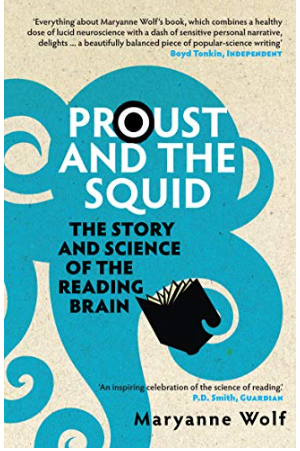
Proust and the Squid: the Story and Science of the Reading Brain (traduit en français par Lisa Stupar : Proust et le calamar). Très bel ouvrage qui raconte l’histoire de comment le cerveau humain, à travers la culture, a bricolé un chemin pour apprendre à lire, car comme l’indique Wolf dès la première phrase de son livre, “We were never born to read” [nous ne sommes pas nés pour lire]. Ce livre, écrit par une chercheuse en neurosciences, est conçu pour un grand public mais s’adresse aussi à tous ceux qui s’intéressent à l’apprentissage de la lecture–parents et enseignants–et à ses disfonctionnements éventuels ; il y a notamment des chapitres révélateurs sur la dyslexie. Les propos sont particulièrement pertinents dans le contexte américain où la méthode appliquée dans une bonne partie des écoles s’avère, de manière assez scandaleuse, inadaptée à l’apprentissage de la lecture et où, en conséquence, cette compétence est en forte régression chez les enfants et les ados (voir Sold a Story ci-dessous). Mais il s’agit aussi d’une belle apologie de la lecture dans notre société moderne, qui tend de plus en plus vers une lecture rapide, condensée, fragmentée et distraite.

Sold a Story, un podcast en 6 épisodes par Emily Hanford pour American Public Media (pas de traduction disponible). Reportage sidérant sur le constat que les enfants américains lisent de moins en moins bien et sur la méthode mise en place dans les écoles américaines depuis plusieurs décennies qui explique en grande partie cette régression.

Poverty by America par le sociologue Matthew Desmond et l’auteur du livre Evicted (2017), lauréat du prestigieux Pulitzer Prize (pas de traduction disponible). Sortie donc très attendue cette année. Je l’ai écouté en version audiolivre. En partant du constat pourquoi y a-t-il autant de pauvreté dans une nation qui est aussi riche que les Etats-Unis ?, Desmond dresse un portrait peu flatteur d’une société qui crée énormément de richesse pour certains, qui fait un maximum pour protéger les riches, mais qui garde les pauvres dans des situations précaires, en éviscérant non seulement les aides sociaux pour ces groupes mais aussi le bien commun. Ses propos lacèrent la gauche comme la droite et pointent le doigt aux cadeaux fiscaux réservés aux classes aisées, à la corruption dans certains états (où les aides fédérales pour les pauvres ont servi de tire-lire pour certains élus et leurs familles), au démantèlement des syndicats … Lecture nécessaire mais aussi pertinent pour les français … c’est un bon rappel de pourquoi il faut absolument protéger d’autres valeurs.

Victory City, le dernier roman de Salman Rushdie. Il sera disponible en français, grâce à une traduction par Gerard Meudal, à partir de septembre 2023. Bon, je ne vous fais pas découvrir ce grand auteur. Dans sa critique du roman pour The Guardian, Xan Brooks le qualifie de « lavish fairytale » (conte de fée somptueux), ce que je trouve assez juste. On rentre très rapidement dans un univers très littéraire, le texte qu’on lit serait la traduction condensée d’un poème/récit écrit au 15 e siècle par Pampa Kampana, l’originatrice d’une ville, Bisnaga, qu’elle a littéralement plantée avec des graines. Tous les habitants de cette ville sont des fictions ; c’est Pampa Kapmana qui leur a chuchoté leurs histoires. Dépaysement assuré.

French retirement reform: why France is on strike

France is on strike. Continents of trash have proliferated, enticing rats into elaborate empire building schemes. The gas stations alternate between deserted wasteland infrastructure and magnetic hubs for hordes of drivers desperate to fill empty tanks. Air and rail travel are intermittent at best. My son’s daycare closed again this week, a decision made at the last minute by the city, due to a shortage of available workers. As I, like most French workers, try to navigate this landscape and ensure a certain level of service and productivity, it occurs to me that my notions of what’s behind the protests are vague at best. Retirement reform, sure. But, at least from an American perspective, it’s a bit hard to grasp why there’s so much hullabaloo over pushing back the retirement age to 64 (from 62). We’re currently at 66 in the United States–67 for those born between 1955 and 1960.

Indeed, much of the American coverage of the movement in France expresses a certain degree of bewilderment and cultural bias confirmation: the French do not value work in the same way as Americans do, and retirement is seen as a “Nirvana of a time when you no longer have to work“; the French are lazy and “the word ‘work’ has a negative connotation” for them; the French are argumentative by nature and prone to striking, so even though “most people voted for Macron, who said he wanted to reform the system […], most people oppose the reforms“. To be sure, there are significant cultural differences between France and the United States when it comes to conceptions of work and the good life. And those differences are, to an extent, relevant to understanding what is going on with the current reform. However, they also obscure more nuanced and salient analyses.

While trying to gain a better understanding of what’s behind the massive contestation in France, I stumbled across a new-to-me podcast by French comedian Marine Baousson called Vulgaire. On a recent episode she does an excellent–and fun–job breaking down what’s at stake in this reform, starting with the change in the retirement age, but highlighting other points that I think reflect a general sense of malaise in France with respect to the economy, fear about a dismantling of the social system, and anger over deceptive, bad-faith communication tactics from the current administration.

Here are some of her main take homes:

  1. The government has posited the idea that, given people’s longer lifespans, the current economics of the retirement system are not sustainable. However, many economists dispute that.
  2. A pension reform was already enacted in 2014 (under Francois Hollande) in response to the issue of longer lifespans. It only recently started coming into force in 2020.
  3. A major incentive for the 2023 reform was actually to balance the books after generous corporate tax breaks. This sounds like a generic conspiracy critique, but it actually appears in “black and white” (to cite Baousson) in the 2023 Budget and the 2022-2027 Stability Program submitted to the European Commission.
  4. The reform disproportionately affects lower income workers whose life expectancies are significantly shorter than higher wage earners. On this point, a beautifully-written opinion piece by French journalist Rokhaya Diallo in the Washington Post puts it well: “mortality numbers vary among social classes. […] Blue-collar workers live six years less than executives, so that one-quarter of the poorest men die by age 62, while 94 percent of the rich are still alive at 64. Only 40 percent of the poorest survive to 80, whereas 75 percent of the wealthiest do. So it’s easy to see who needs retirement income the most.”
  5. The administration plans to eliminate special regimes for some sectors (rail, energy, etc.), with the stated aim of streamlining the system and making it fairer. This has inflamed many unions.
  6. The government claims this reform will better account for professions that are particularly physically taxing. This is simply double speak for an about-face from an administration that is merely reinstating some of the categories it had previously removed from a list of physically taxing professions in 2017.
  7. The government promised the reform would translate to a minimum pension of EUR 1,200/month. It has since walked back this commitment, to much criticism.

In France, the concern over the retirement age is not so much about the usurpation of one’s halcyon years, but about the assault on a social system that strives to protect the vulnerable and ensure a certain level of economic equality. This is perhaps an oversimplification, but here goes: the fear is that Macron’s administration, in its mission to “modernize” France’s economy, is leading the country toward a bleaker, more inegalitarian future, all in the service of capitalism. And, to make matters worse, for many, this shift is being undertaken on false and intentionally misleading pretenses.

To cite Diallo, “Such a mass of people taking days off to defend our social model, which once was praised throughout the world, shows we are ready to stand up for French values.” So, next time the daycare shuts down for strikes and protests, perhaps I’ll take the little one out into the streets. He is half French, after all.

quick thoughts on ai & translation

AI, Chat GPT: these are the buzzwords of the year. The machine mind has gotten smart enough to score in the 90th percentile on the Bar Exam and capable enough of human mimicry to offer plausible self-help advice. There is of course considerable debate as to what its real impact will be: a complete societal revolution followed by the machines taking over the planet and relegating humans to a subaltern role? Or another over-hyped technology, akin to the self-driving cars that were supposed to have put us all in the passenger seat by now?

But there is at least one arena that seems to keep coming up as an accepted point of agreement: translation. Open AI CEO Sam Altman recently mentioned in an interview that he enjoys being able to travel the word and communicate, thanks to technology, with people anywhere. On my favorite podcast, Vox writer Kelsey Piper said yesterday how excited she is for AI in the field of translation, comparing the transition to the shift in the nineteenth century toward machine-made rugs. Putting aside considerations on the quality of communication when traveling with Google or my thoughts on comparing rugs with language and human interaction (perhaps for another blog post), and acknowledging that despite some of my luddite tendencies I am not actually against the idea of technology used in the service of translation (we will all be cyborgs by the decade’s close), I want to take a moment to express my current reservations about these tools.

Out of curiosity, I’ve tried Chat GPT for translation. And in my professional life, agencies and direct clients often ask me to work with specialized translation tools that use both AI and more traditional machine translation methods. I would say that compared to similar systems even a few years ago, the improvements have been massive. Still, given all the hype around these technologies, I am continually surprised at how extensively I have to intervene, often to the point of completely retranslating giant chunks of text. Just this morning, I was working with one such tool that has been trained in industry-specific French to English translation, and to give you a short example of what we translators are dealing with, here are a few of the suggested translations compared to the end translations:

  • “These two models, fitting at the waist” became “These two shoes run small”
  • “Think about changing the price tags” became “Be sure to change the price tags”
  • “Put the product on the reverse side” became “Turn the garment inside out”

I’ve chosen these three examples nearly at random from a list that would be too long to reproduce here. The main criterion for selection was length: I didn’t want to do an in-depth autopsy of a long passage (again, perhaps for another day), preferring to give you a sample that could be grasped quickly and easily. As you can see, the first translation is simply nonsense. The second makes sense but does not convey the proper thrust of the imperative: this is not a suggestion but a command! Finally, while the third translation almost passes in terms of meaning, it lacks flow and naturalness; it sounds like a machine translation.

Ultimately, my point here is this: not so fast! I think there’s a lot to be considered in terms of what will be lost when we start replacing humans with machines for language jobs, from what it will do to the economy to notions about how we communicate with each other and create shared meaning. But for now, my thoughts are very much in the day-to-day work of translating and editing, and I would say that the task of the translator is still very much translation; that is, analyzing and understanding a text in its source (original) language and then, with considerable care and reflection, carrying that message over to the target language so it can be understood by a “foreign” reader.

This is why I am careful about the kinds of ‘post-editing’ (machine translation followed by human proofreading) jobs I take on. Because the language produced by artificial intelligence and machine translation still requires a lot of work. At times, I even ask myself if it takes me longer than a traditional translation, since I have to consider not only the source text but also the suggested translation–twice the reading! Moreover, the power of suggestion is difficult to counter. If the translation provided by the machine is not good–or simply if it could be better–it takes a certain amount of almost willpower to forget it and come up with something else.

My fear is that the promises of AI in this field will serve to drive down prices, even if the “assistance” provided does not save time in a proportionate way.

organizational tools and the laundry break

I recently attended a Zoom networking event between other language professionals. The gist of the session was tips, tricks, and tools for getting organized and staying focused. As the conversation unfolded, it dawned on me that my tips and tricks are fairly rudimentary and old-fashioned. I don’t use Pomodoro or special apps. I don’t turn off access to social media. I don’t really have any hacks to share. And while I was really interested to learn about all the gizmos and gadgets people are using these days to boost productivity, I felt a bit sheepish when the moderator called on me to share from my own experiences.

Mostly, I use a notepad and a day planner to jot down my to-do lists, which I organize into levels of urgency over time. When I finish my goals for the day, I cross them off. If anything is remaining at the end of a day, it gets rolled over to the next day’s list.

In terms of productivity, I would say that having a toddler has made me fairly immune to distractions–at least compared to the pre-parent version of myself. I simply don’t have minutes to spare, and that knowledge has drastically reduced the allure of social media and online shopping. I’ll admit, however, that I can fall into mean research rabbit holes, but even those seem much shallower than before.

Of course, there’s the question of how to manage wildly different projects at the same time. Within the space of a workday, the translator’s mind can be taken on divergent journeys: romance fiction, tourist hotspots, marketing for children’s clothing, EU documentation, and more. Here, I found a good deal of convergence with the other Zoomers: to prevent whiplash, best to segment the day, with bouts of fresh air or household chores between each project. One woman spoke of doing the laundry as a well-deserved break from a tedious proofreading project. I could relate!

translation and research

A conversation with a potential client last week has had me thinking about the disjunct between what people think goes into translation and what actually does. Of course, it’s natural that we don’t understand all the nitty-gritty of other professions. I only have a vague idea of what goes on inside a cockpit or how lawyers spend their days, notions gleaned mainly from Studs Terkel’s 1974 book Working (I jest–kind of) and media portrayals. But, in light of AI’s storm on my livelihood (subject for another blog post) and just for general insight into what happens after you, the client, confirm a project, I would like to clarify an overlooked but vital part of the work of a translator: research.

So the client in question, whose target readers are funeral homes and the bereaved, was very rightly concerned about getting the language just right in English. A translation gaffe here could be less on the order of accuracy and more related to conveying the message in a sensitive and culturally appropriate way. The concern here is two-fold: the translator must both find the habits of language used in the rites and rituals of funeral ceremonies and strike the right note of caring and sensitivity appropriate to grief.

The client, who is interested in both translation and post-editing (AI/machine translation followed by intensive proofreading and editing) services, wanted to know my rate for research. This is a wonderful inquiry from a client. On the one hand, it shows a real attentiveness to the message they wish to put forward, and on the other, it demonstrates a true understanding that research takes time–and time is money.

Yet I do not have an additional rate for research, and that is because research is nearly always inherent to what I do as a translator. Research can be as straightforward as hunting down terms in various language resources–general and specialized dictionaries in French and English, linguist forums, Google searches, and so on. It can go more in depth, pushing me down field-specific rabbit holes. And it can be very academic, as I read and scan through journals, books, and periodicals (my early training in academia is a big help here). I may watch YouTube videos or search through images; I may take time to watch a documentary or immerse myself in relevant literature. The strategies and tactics change depending on the project at hand and, to a certain degree, on my previous experiences.

My educational background in literature, culture, and theory makes me particularly well-suited to translating for cultural fields. However, all kinds of life experiences can be brought to bear in this profession. I am surprised by how often I rely on recollections of my first job as a sales associate at Banana Republic or memories of my environmentalist grandparents. Past translation work has also left a strong mark on my practice, including numerous scholarly publications in postcolonial studies and even romance and detective fiction.

Whatever the project, there will inevitably be some degree of research. This, among other things, is what I am evaluating when I ask to see the original text–or at least an excerpt–before generating a quote. Like many translators, I have a sliding rate scale to reflect the time and skills a translation will require. Many criteria go into this evaluation and of course one of the main ones is research. So, rest assured, dear client, when I send you a quote, the research fee is already rolled in!

2028 ECOC

Disappointed to see that Reims is out of the running for the title of European Capital of Culture in 2028! I had the wonderful opportunity this past fall to work with a small team of linguists on translating the bid documents for the Reims application. This vibrant city, with its history of coronations and culture of champagne, its multi-cultural makeup and ecologically tuned-in population, put forward an ambitious project that brought together myriad groups and actors from all walks of Reims’ diverse landscape. I’m certainly excited to see which city the European Commission ends up crowning for 2028. Here’s the current shortlist: Czech Republic–Broumov and Budejovice. France–Rouen, Bourges, Clermont-Ferrand, Montpellier.

https://www.ecocnews.com/

https://www.reims2028.fr/