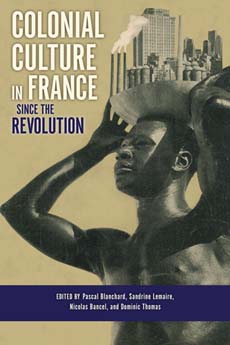
Colonial Culture in France since the Revolution

I am excited to lay hands on Colonial Culture in France since the Revolution! Published by Indiana University Press in November of 2013, this ambitious book gathers together articles written by  an international and interdisciplinary group of scholars, writers, and intellectuals. Colonial Culture in France treats of a multi-faceted historical system, mobilizing a term, colonial culture, to describe “the foundations and origins of the contemporary cultural, political, and social landscape” and the ways in which such a system continues to inform narratives of  identity, memory, and history. This collection, which opens on a discussion of abolitionist movements in the mid nineteenth century and ends with reflections on present day issues,  offers the reader a long and detailed view of the postcolonial situation in France, with articles on such diverse topics as education, science, exhibitions, cinema, sports, propaganda, and tourism — to name but a handful. Colonial Culture in France is available both in hardcover and as an e-book.

On Bookstore Shelves Now: African Lives

African Lives: An Anthology of Memoirs and Autobiographies is now available online and in bookstores. This collection features pieces written by authors from across the African continent and spanning several centuries. As editor Geoff Wisner says in his introduction, the book can be read straight through or by skipping around:

The selections are arranged to follow the map of Africa as
you would read a page in a book: top to bottom and left to right, beginning
with North Africa and continuing through West Africa, Central
Africa, East Africa, and Southern Africa. Within each region, the selections
are in alphabetical order by country. Within each country, they are
arranged chronologically, according to the date of the events described.

Layout 1

By a happy accident, African Lives begins in childhood, with Mohammed
Dib’s memories of growing up in Algeria. It ends in maturity and exile, on
a note of leave-taking, as Chenjerai Hove writes to his mother in Zimbabwe
from his new home in Norway. Between these two voices, I hope you will
find many more to challenge, inspire, and enlighten you.”

This is such a wonderful book, and together with my co-translator, Antoine Bargel, I am delighted to make three newly translated pieces available to the anglophone world: Yasmina Khadra’s The Writer (excerpt); Christian Dumoux’ Childhood in Madagascar (excerpt); Tahar Ben Jelloun’s The Fraternal Bond (excerpt).

Armenian Print Conference

If you’re in Los Angeles during the weekend of November 9 to 11, I highly recommend checking out the Armenian Print Conference, hosted by UCLA’s History Department. I’ve just finished up work on some really interesting papers dealing with the transition from manuscript to print culture, book distribution in early modern Europe, and the trajectory of Armenian printing practices from the sixteenth to the nineteenth centuries.

Follow the link for more details: http://www.history.ucla.edu/events/conference-2

Women Don’t Like Men Who Drink

As an advocate of all forms of book production — from the early manuscript to today’s e-book — I am delighted to be working with French publisher Aux Forges de Vulcain on an e-pub English translation of François Szabowski’s wonderful serial novel, Women Don’t Like Men who Drink.

The book follows the fantastic adventures of a modern Frenchman who moves mountains to find meaningful employment. But his plots and ruses end in catastrophe, forcing him to live off the system and take advantage of the people around him. You’ll learn to love the loathsome character in this entertaining social satire! Keep an eye out for the first installment of the e-book later this year.

Born in 1977, François Szabowski is the son of a Russian mother and a mustachioed father.  He has worked as a florist, a carpenter, an archivist, and a caregiver for the elderly, and now devotes himself full-time to writing.

Translated excerpt:

“A natural hierarchy has set in between me and Auguste. I’m glad. When people come to see us, I’m the one who talks.  And though Auguste had some trouble accepting this at first, he quickly understood that letting him speak was a waste of time and generally against his own interests. To his great delight, I put him in charge of supplies. He often comes by to ask if I need post-its or pencil sharpeners.  Sometimes I say yes to make him happy, and off he gallops to the supply room at the other end of the building. For a whole host of reasons, the task takes him  a good half-hour.  I use the time to go over his work. If he hasn’t made any mistakes, I mix-up up the files he’s arranged or leave a few blotches of ink on the important papers. He doesn’t stand a chance of getting the long-term position I want—there’s no way he’ll make it past the trial period.”

Text in French:

« Un rapport hiérarchique s’est naturellement installé entre moi et Auguste, et je m’en félicite.  C’est moi qui prends la parole pour nous deux quand on vient nous rendre visite, et s’il a eu du mal à l’accepter au début, il a vite compris que lui donner la parole était une perte de temps, et qu’en général parler le desservait.  Je lui ai laissé la responsabilité des fournitures et il en est ravi, il ne cesse depuis de me demander si je n’ai pas besoin de post-it ou de taille-crayons.  Parfois, pour lui faire plaisir, je réponds favorablement et il galope jusqu’au bureau des fournitures, à l’autre bout du bâtiment, ce qui pour toute une série de raisons lui prend toujours une bonne demie heure.  J’en profite pour vérifier son travail, et, s’il n’a pas fait d’erreur, je mélange les dossiers qu’il a classés ou laisse des taches d’encre sur les papiers importants.  Je ne me fais pas de souci sur ses chances d’obtenir le CDI que je convoite—il n’ira vraisemblablement pas au-delà de la période d’essai »
Sub-Saharan African Literature

Yale French Studies published an issue last fall (2011) on “Francophone Sub-Saharan African Literature in Global Contexts“, in which appear articles by scholars and writers from diverse backgrounds on various mutations and transformations in Francophone sub-Saharan literature, particularly with respect to globalization.  Among others, see the piece I translated by Cilas Kemedjio titled “The Suspect Nation:  Globalization and the Postcolonial Imaginary”, in which the author “addresses the tenuous links between nation-building and diasporic formations, nationalism and transnationalism, and therefore globalization itself” (Editors’ Preface, 7).

Collaboration for Words without Borders

I’ve recently had the pleasure of collaborating with French writer and translator Antoine Bargel on a selection of poetry and prose for the May 2012 edition of Words without Borders on “Writing from the Indian Ocean”.  Our contributions include works by the writers Michel Ducasse, Alain Gordon-Gentil, Boris Gamaleya, and Jean-Luc Raharimanana, all of whom, as scholar Françoise Lionnet describes, “imaginatively [engage] with the public and private realms of life in […] historical and strategic insular sites of migration that have brought together the peoples of many continents, near and far” (“Insularity, Mobility, and Imagination:  Writing from the Indian Ocean”).  In these pieces, the raw iteration of the abject, the probing struggle with memory, and the stark critique of global injustice, made for a challenging task of translation and a stimulating read.  I hope you enjoy this issue of Words without Borders as much as I have:  http://wordswithoutborders.org/issue/may-2012