Language Coaching in the Luxury Industry: Behind the Scenes

Working with international luxury houses is about much more than fashion or retail. It’s about storytelling, cultural nuance, and delivering a seamless experience to clients who expect the highest standards. And language plays a central role in that experience.

Over the past years, I’ve had the privilege of collaborating with leading global brands in the luxury sector. My role goes far beyond simple translation: I act as a language coach and communication partner, ensuring that every English interaction reflects the brand’s values and excellence.

What does that look like in practice?

  • Precision in Style and Vocabulary
    Luxury communication requires a delicate balance: descriptive but never overdone, evocative yet concise. I work with teams to refine product descriptions, marketing content, and internal communications so that English texts feel as polished as their French originals.
  • Executive Coaching
    Senior professionals often need to present ideas, negotiate, or host events in English. I provide bespoke coaching sessions to prepare them for high-stakes situations—whether that means rehearsing a keynote presentation, refining answers for international press interviews, or simulating client meetings.
  • Integrated Support
    Sometimes my role includes adapting a PowerPoint presentation into English and then coaching the presenter on delivery. This integrated approach ensures not only that the message is correct, but also that it is delivered with confidence and clarity.
  • Team Training
    In hospitality and retail, English is the bridge between staff and international clients. I design small-group workshops that focus on client-facing communication, helping teams use English naturally, with the grace and precision expected in luxury service.

Why it matters

For international brands, English is not just a tool—it’s often the pivot language that connects teams, markets, and clients worldwide. When the English is off-brand, the message is diluted. But when it’s carefully managed, it enhances the global prestige of the house.

How I can help you

If you’re a professional or company working in high-end sectors—whether in fashion, culture, hospitality, or beyond—I can help you:

  • Deliver presentations that resonate with international audiences.
  • Strengthen your professional English in meetings, negotiations, and correspondence.
  • Support your teams in offering fluent, client-focused service in English.
  • Ensure that your communication reflects the same standard of excellence that defines your brand

Translating Bids for the European Capital of Culture

My city, Marseille, was the European Capital of Culture in 2013. It’s one of the first things locals spoke of when I came house hunting ahead of a move south in 2016: ECoC had transformed neighborhoods, revitalized heritage sites like the iconic Vieux Port, spurred cool initiatives like the GR2013 (a hiking trail linking urban and natural spaces), and funded the first national museum outside of Paris–the MuCEM. So, when an offer came to work with a team of translators on proposals for the 2028 European Capital of Culture, I didn’t hesitate.

I had the opportunity to work on two ECoC bids, at different phases of the bid process and with two separate teams. Each bid was unique, reflecting the singular character of the cities vying for the title and the visions of the program designers. But the parameters of the selection process and the European Commission’s vernacular also afforded a certain familiarity to the task the second time around.

Challenges for these projects included:

–> Time

Our teams faced extremely tight, hard deadlines and evolving source texts as the bid teams made updates to the French document right up to the last minute. Time was the reason behind dividing up the work among three linguists, since the volume of work was simply too large for a single translator to handle. We also streamlined communications with the bid team by creating a Google Docs query sheet and WhatsApp group for on-call requests.

–>Multi-handed translation

To meet the time constraints, we worked as a team of two translators and one reviewer, with one translator (me on project two) acting as the project lead to interface with the client. Maintaining consistent language and tone of voice are key challenges on group translations. We had two initial calls–one with the client and one internal team call–to set out some basic guidelines and align on client expectations as well as lexical preferences. We also worked in a Computer Assisted Translation tool with an editable glossary and constantly updating Translation Memory. This allowed us to gain maximum consistency as we worked, but of course the final review was critical to harmonize key terms and style preferences, as well as to ensure the client guidelines had been respected throughout.

–>Client interfacing

These translations were done within an agency, where typically the Project Manager handles the bulk of client interactions. Our team was well supported by the PM, but the specifics of these projects–time crunch, evolving source text, very hands-on clients–meant more direct contact between the linguists and the bid writers. I was designated as the project lead on the second bid, which meant acting as the face of our team for the client, responding in real-time to updates and queries, and keeping our team informed of actionable client communications. I participated in several calls throughout the process to explain translation choices, better discern client expectations, and manage last-minute requests.

–>Translating for non-native speakers

The jury reading ECoC bids is composed of European readers for whom English is not likely their mother tongue. The language required is therefore not necessarily the most idiomatic or ‘native’ English. Instead, the focus is on creating clear, direct phrasing. With French as the source text, this involved simplifying syntax and breaking apart intricate sentences, but without losing any of the content or intention.

–>Research

Cultural projects are typically research intensive, involving searches for standard translations of organizations, works of art, and so forth, as well as contextual deep dives into artistic movements and cultural figures. ECoC bids, which tend to include an overview of a city’s cultural and historical heritage as well innovative initiatives by established and emerging contemporary artists for the ECoC year, are particularly research heavy. Again, the time constraints on these projects added significant pressure since research is always time consuming. We reduced some research time by pooling knowledge in a Google Sheet shared with our language team and targeted client querying.

As deserving as they were, our ECoC bid cities did not win the title, but I’m thrilled to learn that Bourges–the Territory of the Future–will be the 2028 European Capital of Culture for France, and I’m excited to see how the organizers will showcase the city and its cultural offering.

Translating Terrestrial Cities

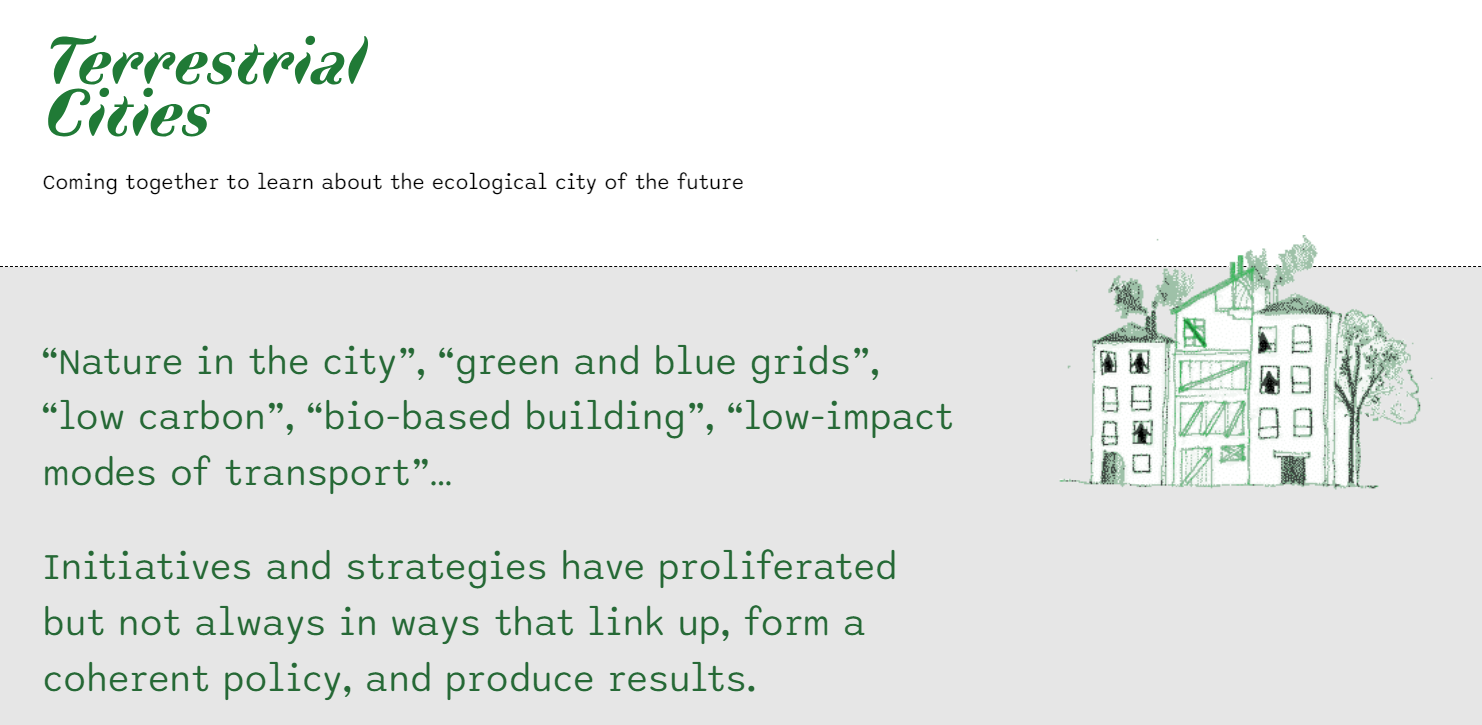
Terrestrial Cities is an initiative aimed at giving urban decisionmakers and city dwellers the tools to create environmentally harmonious and sustainable urban spaces, distinguish between truly transformative policy ideas and greenwashing, and — no small feat — save the world, one city at a time, from an ecological doomsday. To do this, the minds behind Terrestrial Cities have developed an interactive card game to be played between four+ people and one facilitator.

The job here was to translate the website, card game, rules, and facilitator handbook from French to English.

Challenges and particularities of the job included:

–> Researching environmental terminology and movements

–> Hunting down quotations that had been translated into French from English sources.

This can be a time-consuming process, especially for out-of-print resources. A particular challenge was finding quotes from Ivan Illich, who wrote and published works in multiple languages, with variations in each language. Resources were found through extensive Google searches, Scribd, e-books, client queries–and after poring over texts to find the exact citation (the Find feature is helpful here, though not always).

–> Some source formatting inconsistencies

This is a common issue, particularly for texts that are written over time by many authors, as was the case here. Good practice is to flag source formatting inconsistencies in the query process with the client. It helps the client improve their materials, and ensures the translator is following the ideal formatting consistently in the translation.

–> Not falling down interesting rabbit holes!

This project was so fascinating on so many levels, since it covered all kinds of possible solutions to environmentally problematic urban infrastructure. It was a real challenge not to spend copious amounts of time learning about all the ins and outs of transportation, energy, building materials, and more.

Check out the initiative here: https://www.villes-terrestres.org/en

111 Museums in Paris

What fun it was to participate behind the scenes in the translation of the French entries of this unique guidebook. Sitting here at my desk in Marseille, I was able to discover and rediscover gem locales all over the City of Light, including 19th-century cabinets of curiosities, a surprisingly endearing museum of hunting and natural life, a round-the-clock outdoor sculpture museum, and so much more. Author Anne Carminati does a fabulous job making even the big institution museums seem fresh and intimate. And working with Karen Seiger, the charming editor of this series, was a treat in itself.

Challenges on the translation end of this project included:

–> This book was authored by two ‘guides’–one French (Anne Carminati) and one American (James Wesolowski) –so part of the job involved keeping Anne Carminati’s tone of voice, while harmonizing the translation style with the existing American copy.

–> Reviewing and incorporating the 111 Style Guide preferences. As I’ve mentioned elsewhere, adapting a translation to a House style guide (or client style preferences) is an important part of any translation project.

–> Familiarizing myself with the different museums. Each entry in a guidebook requires some research to ensure that I’m accurately translating descriptions. I also ‘fact check’ a bazillion details, including proper names, cultural references, addresses, artwork titles, etc.

Learn more about 111 Museums in Paris and its authors, and pick up a copy, here: https://www.111places.com/111-museums-in-paris

new listening find: The editing podcast

So thrilled to have discovered this podcast by an editor I follow on social media:

https://www.louiseharnbyproofreader.com/podcast.html

I’ve just listened to an interview episode with Andy Hodges from July on Editing Translated Materials. Many interesting points are covered here, including:

–> evaluating the level and type of editing to apply based on the purpose of a text (literary for publication? academic for publication or presentation?)

–> the differences and similarities between editing translated texts and editing texts by authors for whom English is not their primary language

–> things to look out for in translated texts: accurate and consistent use of terminology, register errors, appropriate and consistent voice/style

–> differences in publishing/literary traditions: In some cultures “head hopping” is not a strict no-no and using dialogue tags other than “said,” “asked,” and “replied” is encouraged (definitely the case in French fiction)

I can’t wait to listen to more episodes, on topics like “5 ways editors can use text generative AI as a business tool,” “How to manage a hectic editorial business schedule,” “5 ways to be a more efficient editor and proofreader,” and “Editorial humility: Who’s the boss of the book?”

Bundled Services: When Translation Isn’t Enough

For some translation or proofreading projects, polishing the written word is only part of the job. In many cases, a text can stand alone. But there are documents that interact with the world entirely differently. Some are made speech through an intermediary. Dramatic texts for a theater production or movie come to mind. Others straddle the oral and visual worlds, appealing to a readership and requiring interpretation. A few examples from my work include: restaurant menus, corporate presentations, guided tours.

Restaurant menus–like recipes–are notoriously resistant to translation. A culinary tradition is rooted in a place, the specific ingredients at times only available in a local setting, the techniques honed over a long history. France has been a capital of gastronomy for centuries, and many dishes and foods are now familiar to travelers. Coq au vin, boeuf bourguignon, quiche lorraine. These terms don’t need translation, only perhaps a brief explanation in the subtitle to the menu entry. Other dishes pistou, aioli, panisse (can you tell I live in Marseille?), though not as well known, should be treated the same way: no translation in the title, but perhaps a brief description in the subtitle. Aioli, for instance, is a complete dish in the south of France, consisting of a bevy of steamed/boiled vegetables, hard boiled eggs, cod, and the famous garlicky/mayonnaise sauce–what Anglophones think of when we see the word aioli.

Okay for local dish names. What to do with terminology like boeuf charolais? Many foreign diners would be interested to know that this is an AOC beef from a breed raised with all the savoir-faire of its terroir (the Gallicisms start to feel inevitable)–Charolles in eastern France. But too much annotation can turn a menu into an academic paper.

One of my best restaurant experiences in France while dining out with non-French speakers was at a little restaurant in Cours Julien–Marseille’s cool-kid restaurant scene. The service was friendly–enthusiastic even. And the waiter did not content himself with handing out translated menus and taking orders. When he found out New Yorkers, Californians, and Oregonians were in the house, he made a point of coming around to discuss the menu, describing the dishes, the ingredient origins, and the culinary techniques. And this practice went beyond a single excited waiter. When I returned with another group of foreigners, the waitress had changed but the experience was identical. This was restaurant policy.

The experience inspired me to develop a bundled service for these types of intermediary texts: translation and/or proofreading + targeted language coaching. I work closely with restaurants to create menus in English that best convey their aesthetic to Anglophone diners. And then I spend time with their teams, coaching them on ‘restaurant English’, teaching them the vocabulary that’s relevant to the menu, and giving them the tools to best represent their restaurant and culinary tradition.

Menus, PowerPoint presentations, cultural brochures: These are all documents that should be written or translated accurately, flawlessly, and with native flow. However, these materials do not stay on the page. They are brought into an interplay where a waiter, presenter, or tour guide will act as an authority. That can be daunting for some professionals, even those with a good mastery of English. A bundled translation/proofreading + coaching service gives professionals the confidence to act as ambassadors for their brands.

4 ways becoming a parent has made me better at my job

It’s no secret that becoming a parent, the mom kind in my case, completely changes one’s relationships, priorities, body, home, work–everything. Anthropologists have even coined the term matrescence (contraction of maternity and adolescence) to describe the radical transformation that takes place, even at a cellular level, in a woman’s life when she becomes a mother. But for some reason (media representations? the social disconnect between parents and non-parents? willful disbelief? biological blindness?), in the months leading up to becoming a first-time mom, I had no idea what to do to prepare my career for what was about to happen. This is a vital issue, particularly for freelancers, particularly for mothers (still in 2023, for all kinds of reasons), which I will definitely address more directly in a future blog post. Suffice it to say that getting back to full-time work as an independent translator has been hard fought. But in addition to the challenges of mothering a small child while also trying to rebuild, sustain, and grow an independent business, there have been some surprising benefits. As I reflect on my matrescence applied to the world of work, I can honestly say that since giving birth to my son, I have become better at my job in at least 4 important ways. And I am genuinely curious to hear about other people’s experiences. Do you think having children has had a positive impact on your professional self? And in what ways?

  1. PRACTICAL KNOWLEDGE

As a linguist, I rely on all kinds of life experiences to get the language just right for a given text. Prior to becoming a mother, I worked on accounts for children’s brands. In the pre-child years, I had to spend extra time researching vocabulary and concepts specific to the world of early parenthood. Today, understanding the difference between a sleep sack and footed pajamas has gone beyond intellectual knowledge, it has become a part of my own story. I now know, on a deep level, what these kinds of objects mean to parents of babies, and I believe that shows through in my work. As my son grows, his interests begin to fan out beyond my own tastes and preferences. He’s becoming his own person, and as he does, he introduces me to new worlds and new experiences, all of which enrich my life and work.

2. PROFESSIONALIZATION

For me, I think it took becoming a parent to truly realize that I was a professional. It’s not that I didn’t take my job seriously before. It’s just that now I understand how important it is to set limits, stand up for my work and the work of others in my field, and take stock of what I do. This has translated into establishing realistic deadlines that ensure I can deliver high quality work; negotiating budgets that value the time, experience, and expertise I bring to a job; taking part in more professional growth activities (continuing education, association membership); and spending time reflecting on practice (this blog is part of that!).

3. PRACTICE

Reading with a child is one of life’s deeply pleasurable experiences. There’s nothing that can beat those moments cuddled up together, his tiny face engrossed in the pictures on the page. And from a linguistic perspective, children’s literature is rich with images, sounds, and plays on words. The attention to the mouth feel of words is particularly salient in this genre, much more so than in most contemporary adult literature. It’s such a wonderful daily reminder of how words sound and feel, which is important in the creation of a translation as well. Many words can say the same thing, but only some will truly pop in a given context.

Another way in which reading with my child flexes my translator muscles is the instant translation I now do of all non-English books that come into our home. This is a choice we’ve made in our bilingual family: Dad speaks with the kiddo in French and I speak with him in English. I take this decision particularly to heart since we live in a Francophone environment, so every day I work and rework (since kids love repetition) my Anglophone versions of Tchoupi, the p’tits docs series, Babar, and all the other Gallic children’s books on our bookshelves.

4. THE HUMAN TOUCH

Being a parent has become an integral part of who I am, a facet of myself that comes into dialogue with everything I do. As a professional, it has made me more empathetic, better attuned to my clients and their needs, more aware of my own strengths and limitations, and simply more human. In our society’s drive toward ever more technology, increasing isolation and social distancing, I have become more and more convinced of the importance of highlighting the human in what we do. I enjoy taking the time to discover who my clients are as people and professionals, understanding their audiences, and creating language that best reflects them.

By the way, this podcast, La Matrescence, by the French sports journalist Clementine Sarlat has been an incredible resource and inspiration for me on all things early parenthood: https://clementinesarlat.com/podcasts/la-matrescence/

style guides

The week has been hectic, particularly since Monday was a holiday in France–Easter 🐰. I feel like I’ve been rushing more than usual as I try to meet deadlines, stay on pace for larger projects, and meet with prospective clients.

A recurring theme this week (since every period seems to have its leitmotiv) has been style guides. I love it when clients come to me with detailed style guides that cover all the nuts and bolts of putting a text together, like whether or not to use the Oxford comma, or more intangible aspects like tone, vision, and target audience. There are many ways to communicate a message, and there are many different conventions one can follow. A style guide helps translators understand client expectations and get the language just right for a specific project.

Many clients don’t come armed with a style guide, and that is why I like to spend some time at the beginning of any project–big or small–going over some basic questions. What is the mission of your text? Who are your readers? Should I follow UK or US spelling conventions? Should measurements be converted into inches and feet?

Of course, I have my own preferences (Oxford comma ✅, American spelling [Merriam Webster]✅, Chicago Manual of Style ✅), but I always adapt to those of my clients. The key is to work together so that I can put my expertise at the service of your message.

By the way: One blogger and podcaster I find really helpful when it comes to subtleties in English grammar is Mignon Fogarty, the founder of Grammar Girl.

Why Machine Translation is Not My Bogeyman

File:Gustave Doré - Dante Alighieri - Inferno - Plate 13 (Canto V - Minos).jpg
Gustave Doré – Dante Alighieri – Inferno – Plate 13 (Canto V – Minos)

There are many misconceptions about the job of translators. When I get out from behind my computer and into the world, the people I interact with, from family members to other professionals to parents in my son’s 0-3 play group, inevitably do one of the following: treat me as a human dictionary, express skepticism about my stance on not translating out of my mother tongue, act surprised I don’t speak a gazillion languages, give me a sly look as they ask about machine translation and what they assume is my impending obsolescence. An author once jokingly admitted his astonishment at meeting a real live translator, as if I were a rare specimen, one bound for extinction. (I went on to translate several of his books.) Even though much of what we do as translators happens remotely, and so necessarily through the mediation of machines, our task remains inherently human. I have no interest in reading a novel or poem written by a robot, since how can a machine give me insight into the human soul? Likewise for a translation made entirely through machine translation: how can technology understand and render all the nuance, tone, cultural innuendo, and je ne sais quoi of great literature? Indeed, the fact that some books get retranslated again and again, to better speak to different generations of readers, is telling.

Yet machine translation, particularly together with other features of Computer Assisted Translation tools, is becoming more and more vital to our work, making us more efficient, less prone to error, and better able to collaborate—provided, that is, we know when and how to make use of these tools. For some texts, they can be an asset. Translation software is often a good solution for documents featuring a lot of repetition, since it helps translators be consistent in their vocabulary choices and can free up mental space for more challenging areas of the text. It can also ensure that numbers and dates don’t get distorted through typing errors. Moreover, in my work as a translation proofreader, I have come across many translations with missing sections of the original text. This can happen when translations are made under tight deadlines that don’t give translators the time to review their own work against the source text. But, even under time constraints, it can be avoided with the help of translation software. Finally, for large, on-going projects (as in some legal cases, long-term marketing campaigns, etc.) software can help translators work together and provide consistent language choices, even over periods of many years.

In my experience, machine translation tools are not well suited to literary or even academic translation. In addition to the loftier ideals mentioned above, I attribute this in large part to parsing. Most translation software parses texts into sentence-by-sentence segments and will then provide translation suggestions, recommended vocabulary, and so forth. But a literary translator needs to work not only at the minute level of the sentence or the individual word, they also have to grasp the larger whole, which can sometimes call for work on a more architectural scale as the translator rebuilds a section to better reflect what the source text is up to. Even the suggestions given by machine translation can be a nuisance, cluttering the translator’s mind and preventing them from straying away from the source text’s syntax, for example, to find other, less obvious solutions.

Similar reservations can be expressed for academic translation, though there is one thing I would like to add: academic style. Cultural differences apply not only to the content of what is being expressed but to the form. The ways in which we express ideas, including sentence length, the amount and type of jargon used, what we consider “smart” language, the acceptable use of repetition or passive voice, and so many other factors, can vary dramatically from one academic culture to the next. And this cultural straddling, this refashioning of a text to make it cohere with the target culture’s expectations and norms: this requires human judgment.

I am a translator, and I am not afraid machine translation will put me out of a job. Machine translation is one of many tools at my disposal to provide the best possible translations for my clients. Now, what is my bogeyman? A last-minute babysitter cancellation when I’ve got a deadline coming up. Or the Internet going down …

The American Translators Association has a useful position paper on machine translation: ATA Position Paper on Machine Translation: A Clear Approach to a Complex Topic. Their takeaway: “Professional translators and machine translation engines work together very well. […] If reliable and secure translation is desired, machine translation should not be used without the ongoing involvement of professional translators.”